
Newsletter No. 179
Good afternoon,
There’s a lot moving in energy this week. Shipping through the Strait of Hormuz slowed again as tensions increased, helping push Brent above $91 and WTI above $85. At the same time, the White House is putting more focus on North American energy infrastructure, including renewed talk around Keystone XL, which could have important implications for U.S. oil and gas.
We also have a new episode of The Jay Young Show with Brock Murphy, who worked at both SpaceX and the White House before building his own company at just 24. He shares what he learned about leadership, ownership and building a business at a young age. Don’t miss the rest of this week’s The Upside for the full stories, what they mean for U.S. energy, and this week’s conversation with Brock.
This Week's Headlines
Oil and Gas News
- Distillate Inventories Tighten as Crude Holds Steady
- Hormuz Tensions Deepen as Shipping Slows
- Texas Power Demand Could Hit Another Record
What's Happening at King
- He Left SpaceX to Build His Own Company at 24: Brock Murphy on The Jay Young Show
- Upcoming Webinar: America's Energy Moment: The Global Energy Shift
- Oil & Gas Rundown LIVE! If you Missed It
Energy Market Perspective
-
Keystone XL Revival Signals Renewed Focus on North American Energy
Move to Watch
-
Exxon-Targa Deal Signals More Permian Growth
Oil and Gas News
At the same time, the U.S. pulled another 5.3 million barrels from the Strategic Petroleum Reserve, bringing SPR inventories to 293.4 million barrels, near the lower end of the commonly cited operational range. Gasoline stocks rose modestly, while Cushing inventories fell by 1.4 million barrels.
With U.S. production near 13.8 million barrels per day and Brent around $91, the data shows a market that may look relatively balanced on crude inventories but remains much tighter underneath, especially in refined fuels.
Hormuz Tensions Deepen as Shipping Slows
Shipping through the Strait of Hormuz slowed again this week as vessel operators responded to rising security concerns. Only six commodity vessels passed through the Strait on Tuesday, down from nine on Monday and well below recent averages, with some tankers reportedly turning around or changing course after a cargo vessel was struck by an unknown projectile.
At the same time, tensions between the UAE and Iran escalated sharply. The UAE suspended all trade, commercial exchanges and financial transactions with Iran after accusing Tehran of launching two ballistic missiles toward its territory. Iran denied the accusation.
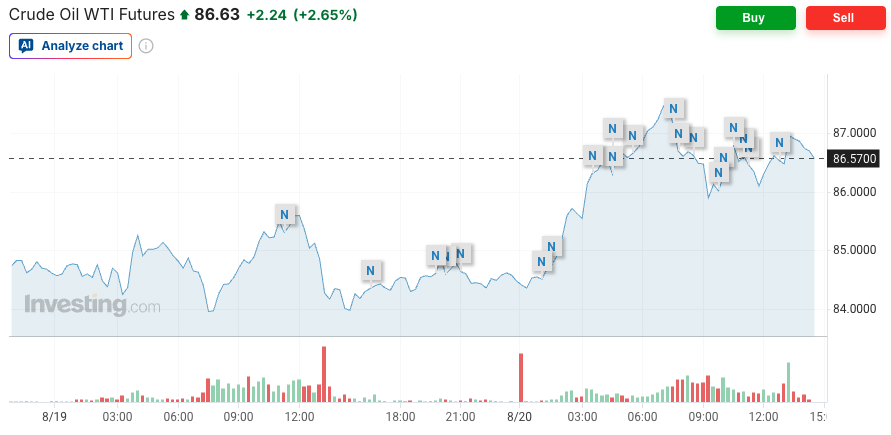
The combined developments are increasing uncertainty around one of the world’s most important oil transit routes. While the U.S. says the Strait remains open, reduced vessel traffic and growing regional tensions are raising supply concerns. Brent crude has moved above $91 per barrel, while WTI is trading over $85, as oil prices rise on concerns over potential disruptions to Middle East supply.
Texas Power Demand Could Hit Another Record
Texas is heading into another stretch of extreme heat, and ERCOT expects electricity demand to break its all-time record later this week.
Temperatures could reach 105 degrees in Dallas and 99 in Houston, pushing air-conditioning use higher just as wind generation is expected to fall sharply. Solar and battery storage should help, but lower wind output could put more pressure on natural gas-fired power plants.
That combination of record demand and weaker wind generation could also support natural gas prices as Texas relies more heavily on gas to keep the grid balanced.
| Get Oil & Gas Insights |
| Book a Meeting |
| Learn More |
Happening at King

Energy Market Perspective
Keystone XL Revival Signals Renewed Focus on North American Energy
U.S.-Canada trade negotiations are putting energy infrastructure back in the spotlight. President Trump has temporarily delayed threatened 50% tariffs on Canadian goods while the two countries work toward a broader agreement, with several key trade issues still unresolved.
As part of those discussions, Trump raised the possibility of reviving the Keystone XL pipeline, which was designed to carry roughly 830,000 barrels per day of Canadian crude into the U.S. While no formal agreement has been announced, the proposal reinforces a broader policy shift toward expanding North American energy infrastructure and strengthening crude transportation capacity.
The bigger takeaway is the growing emphasis on energy security, pipeline access and reliable domestic and regional supply. Additional infrastructure could improve crude flows into U.S. refining markets, reduce transportation constraints and support a more resilient North American energy system.
For U.S. oil and gas investment, the trend is significant. A policy environment that prioritizes production, infrastructure and energy security can create a more supportive backdrop for domestic development and reinforce the long-term strategic importance of U.S. oil and gas assets.
Learn More about how King Operating Corporation is helping develop the energy America needs for the future.
Move to Watch
Exxon-Targa Deal Signals More Permian Growth
ExxonMobil and Targa Resources have signed 20-year agreements to expand natural gas gathering, processing and NGL infrastructure across the Permian Basin.
Targa plans to build three new Delaware Basin processing plants with a combined capacity of 825 million cubic feet per day, along with a 70-mile pipeline to the Waha Hub. The projects are expected to be in service in 2028 and could require more than $1 billion in investment.
The deal matters because more pipeline and processing capacity gives Exxon room to increase oil production without being held back by the natural gas that comes with it. It is another sign that Permian infrastructure is still expanding to support future production growth.
All the best,
Jay