

Newsletter No. 162
Good afternoon,
This week, energy markets are being shaped by renewed volatility in oil prices, ongoing tension around the Strait of Hormuz, and rising concerns about global supply security. In this week’s issue of The Upside, I am breaking down the biggest forces moving the market right now, what they mean for the U.S. oil and gas industry and why America’s role as a stable energy producer matters even more in today’s environment. I am also sharing updates from King and the key market signals I’m watching closely this week.
This Week's Headlines
Oil and Gas News
- WTI Pushes Back Above $91 on Fresh Hormuz Tensions
- Iran Shock Lifts Stakes for U.S. Oil and Gas
- Global Oil Inventories Near Historic Low
Energy Market Perspective
- JAPEX’s U.S. Expansion Is a Good Sign for American Oil and Gas
- Ask the "Tax Guy"
What's Happening at King
- On the Latest Episode of The Jay Young Show: Rob Thummel on Oil Prices, Natural Gas, LNG & AI Energy Demand
- UPCOMING TAX WEBINAR: Did You Pay Too Much in Taxes This Year?
- Don't Miss an Episode of the Oil & Gas Rundown LIVE!
Move to Watch
- Fervo Eyes IPO with Shale-Style Geothermal Model
Oil and Gas News
WTI Pushes Back Above $95 on Fresh Hormuz Tensions
WTI crude strengthened this morning, climbing to about $95.85 per barrel, as traders reacted to renewed security risks in the Strait of Hormuz and tighter-than-expected U.S. fuel inventories. Reuters reported that multiple vessels were hit by gunfire in the strait and Iran seized two container ships, keeping supply disruption fears elevated. At the same time, President Trump’s indefinite ceasefire extension remains in place, but peace talks still appear stalled and there is no clear sign of Iranian acceptance. After hovering below its 20-day EMA earlier, WTI has regained upside momentum, with geopolitical risk once again driving price action
Iran Shock Lifts Stakes for U.S. Oil and Gas
The Iran war and Strait of Hormuz disruption have created a historic global oil supply shock, removing more than 12 million barrels per day from the market and intensifying pressure across crude, gas, and refined products. For U.S. oil and gas, the setup can be constructive: higher and more volatile WTI tends to strengthen domestic well economics, support producer margins, and increase the strategic value of U.S. supply as customers seek more reliable barrels outside the Middle East.
Global Oil Inventories Near Historic Lows
Global oil inventories are moving toward record lows as the Middle East war continues to disrupt production and tanker traffic through the Strait of Hormuz. Analysts say that even if the strait reopens soon, inventory declines are likely to continue through May and June. The conflict has already taken millions of barrels per day offline, damaged more than 80 oil and gas facilities, and created a severe supply squeeze. Experts warn that restoring normal production could take months, with some countries needing much longer than others to recover.
Energy Market Perspective
JAPEX’s U.S. Expansion Is a Good Sign for American Oil and Gas
JAPEX’s decision to put a large share of its future investment into the United States is a positive sign for U.S. oil and gas producers. It shows that a major international energy company believes American oil and gas assets are still some of the safest and most attractive places in the world to invest.
Global capital is still coming into U.S. energy, supporting the idea that American oil and gas remains valuable, especially for companies with strong assets and solid production potential. It can also help support asset values and create more interest from buyers and investors over time.
The bigger takeaway is that energy security matters more than ever. With global uncertainty still high, companies want stable and reliable supply, and the U.S. continues to stand out in that environment. For planners looking at energy as part of a broader investment strategy, this is another sign that U.S. oil and gas can still offer long-term opportunity.
Ask the "Tax Guy"
Tax treatment is one of the most important, and often most overlooked, aspects of oil and gas investing. From deductions and income classification to timing and reporting, the structure and activity of an investment can meaningfully affect an investor’s overall outcome. For accredited investors evaluating opportunities in this space, understanding how tax rules apply is just as important as understanding the asset itself. We asked our EVP of Tax, Rex Gifford:
Q. Current Year Non-Cash Deductions Considerations and Comparison: Depreciation and Depletion; what are the similarities and differences?
A: Both Depreciation and Depletion current year deductions represent “Non-Cash” Deductions. For income tax purposes, both deductions reduce the cost basis of the Partnership’s assets. For Depreciation, the Lease and Well Tangible Costs reported on the Partnership’s Balance Sheet is reduced annually by the amount of the Depreciation Deduction. Also, for the Depletable Assets reported on the Partnership’s Balance Sheet, is reduced annually by the Depletion Allowance.
With regard to Depreciation deductions, any tangible, physical assets acquired and placed in service during the current tax year requires the computation of a new depreciation deduction (allowance) for these tangible assets acquired. Typical oil and gas tangible equipment consists of below the surface and surface components. Examples of below the surface are 1.) all sizes of downhole casing, generally cemented in place, 2.) downhole assemblies and spacers, 3.) tubing, usually 2 3/8” or 2 7/8”, and 4.) rods. Examples of surface components are: 1.) wellhead, 2.) flow lines, 3.) pumping units and applicable electric motors, 4.) electric panel controls and boxes, 5.) separator or heater treaters, and 6.) other applicable tangible equipment.
Depreciation Deductions are usually computed by applying a useful life to a specific tangible equipment item and then applying an approved depreciation method for computing the annual depreciation. For oil and gas tangible equipment, the useful life required is typically seven years and the most common method of depreciation is MACRS (Modified Accelerated Cost Recovery System). This depreciation method was developed and became IRC Section 168. With the passage of the Big Beautiful Bill as of July 4, 2026, the provisions of IRC Section 168 (k) was modified. This modified section was permanently modified to allow for 100% of tangible costs, with useful lives under twenty years, to be deducted in the current tax year by claiming “bonus depreciation” for the tangible equipment acquired and placed in service in the current tax year. Claiming “Bonus Depreciation” for tangible equipment eliminates the requirement to depreciate the tangible equipment over the usual seven year useful life applying MACRS as the depreciation method.
With regard to Depletion Deductions (Allowances), the greater of either 1.) cost depletion or 2.) percentage depletion may be claimed annually, thereby reducing the Depletable Assets reported on the Partnership’s Balance Sheet. IRC Sections 611 – 614 provides the authority, computation, and limitations for claiming depletion deductions. Examples of Depletable Assets capitalized are 1.) Cost of acquiring oil and gas mineral rights through the negotiation of an oil and gas mineral lease or oil and gas mineral acquisition, 2.) acquiring an economic interest in the oil and gas minerals, and 3.) other such costs which are required for the right to drill within the boundaries of a specified area. Depletable Assets do not include the acquisition of surface rights.
Depletion deductions are computed on an annual basis and the greater of 1.) cost depletion or 2.) percentage depletion (subject to specific limitations) may be claimed. Refer to the comparison of the two methods below:
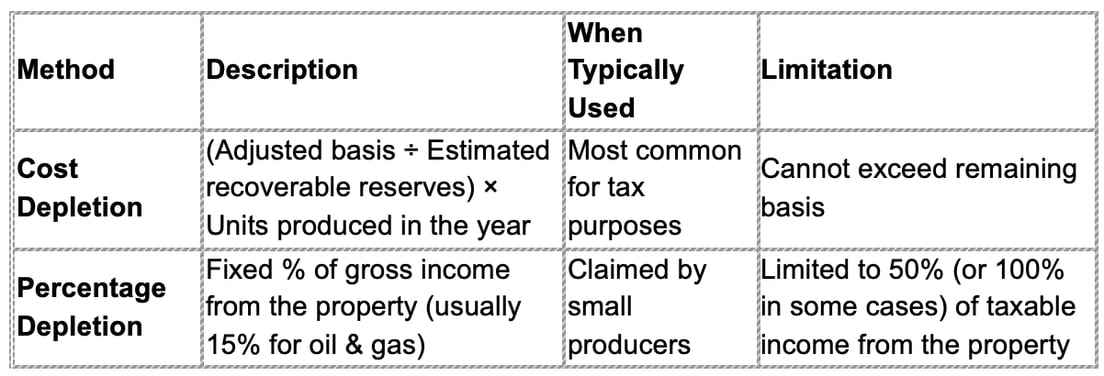
Percentage depletion can continue even after the entire cost basis has been recovered (i.e., Percentage depletion deductions may be claimed annually as long as the well commercially produces). In other words, the Depletable Assets Balance Sheet amount could be reduced to zero by previous claimed depletion deductions. Subject to the limitation, stated above, of being limited to 50% or possibly 100% of the taxable income from the property, percentage depletion may be claimed annually until the well ceases to commercially produce. This percentage depletion deduction, therefore, provides an annual reduction of taxable net production income equal to 15% of the gross production income.
As stated above, both depreciation and depletion deductions provide the method for claiming annual deductions for the cost of either tangible equipment or the acquisition of oil and gas mineral interest which conveys the right to drill within the boundaries of a specific oil and gas mineral lease.
Have a tax question you’d like covered in a future issue? Email it to theupside@kingoperating.com.
DISCLOSURE: For educational purposes only. Not tax, legal or accounting advice. Please consult your tax professional before making any investment or tax-related decisions.
Happening at King

On the Latest Episode of The Jay Young Show: Rob Thummel on Oil Prices, Natural Gas, LNG & AI Energy Demand
In this week's episode of The Jay Young Show, my co-host Jordan Soto and I sat down with Rob Thummel of Tortoise Capital to break down the biggest trends shaping oil, natural gas, LNG exports, energy investing, and the future of AI-driven power demand. From the long-term outlook for crude oil prices to the growing role of natural gas in data centers and grid modernization, this conversation covers the forces driving the energy market right now.
Rob shares his take on why energy remains essential to global growth, how oil and gas investors should think about 2026 and beyond, why LNG has become a global story, and how AI infrastructure could become a major tailwind for U.S. natural gas demand.
Watch it on LinkedIn, Rumble and YouTube (@JayRYoungOfficial).
Don't Miss an Episode of Oil & Gas Rundown LIVE
Join us live every Wednesday at 2 p.m. CT for Oil & Gas Rundown LIVE, where we break down the latest headlines, market moves, and industry developments shaping oil and gas in real time. It’s a chance to stay current on up-to-the-minute energy news, hear sharp insights on what matters most, and get a clearer view of where the market may be headed. Whether you follow the industry closely or just want a smart, timely update each week, this is a conversation you won’t want to miss.
YouTube: @JayRYoungOfficial
LinkedIn: jayr-young
Move to Watch
Fervo Eyes IPO with Shale-Style Geothermal Model
Fervo Energy, backed by Devon Energy and investor John Arnold, is preparing to go public as it scales a geothermal development model that borrows heavily from U.S. oil and gas shale techniques. The company uses fracture-stimulated horizontal wells to unlock deeper heat more efficiently than traditional vertical geothermal wells, sharply lowering drilling time and cost. With major projects underway in Utah, Nevada, and Idaho, Fervo says it has significant contracted revenue and growing power demand support. Its approach highlights how technology and expertise developed in U.S. oil and gas are increasingly being applied to new energy markets.
If you'd like to talk to someone about King and are an accredited investor, you can fill out your information here or schedule a Zoom conversation with one of our SVPs here and someone will reach out.
All the best,
Jay