

Newsletter No. 159
Good afternoon,
There is never a dull moment in oil and gas, and this week is no different. In this week’s The Upside, I’m breaking down the latest industry headlines, what WTI is doing, and the key market moves shaping the day. I’ll also share updates on what’s happening at King and why strong U.S. oil and gas production remains critical not only for economic growth, but for America’s safety, security, and stability at home and abroad. My goal is to give you a clearer view of the market, the trends that matter most, and the opportunities worth watching.
This Week's Headlines
Oil and Gas News
- EU Warns High Energy Prices May Stick Around
- Diamondback Sees Higher Oil, Stays Careful
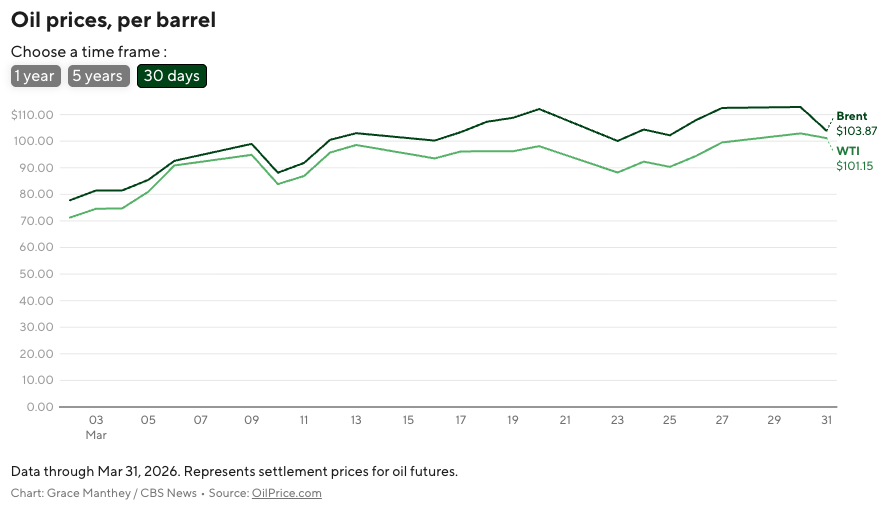
- Strait of Hormuz Closure Could Send Oil to $150–$200
Energy Market Perspective
-
Why “Long Hydrocarbons” and Digital Infrastructure Are Converging
- My Latest Kiplinger Article: What the Oil Market Is Telling Us About Energy and Gas Prices
- Ask the "Tax Guy"
What's Happening at King
-
On the Latest Episode of The Jay Young Show: Self-Storage Investing, Real Estate Cycles & Alternative Asset Wealth Building
- Don't Miss an Episode of the Oil & Gas Rundown LIVE!
Move to Watch
-
Chevron, Microsoft Eye Major Texas AI Power Project
Oil and Gas News
EU Warns High Energy Prices May Stick Around
The EU says energy prices probably will not drop back to normal soon, even if the Iran war ended right away. In just one month, the conflict has pushed natural gas prices in Europe up about 70% and oil prices up about 60%, making energy much more expensive for the region. Officials say the war has disrupted fuel and gas supplies, especially LNG shipments, and made it harder for Europe to prepare for next winter. The EU is now working on ways to protect families and businesses from higher energy costs.
Diamondback Sees Higher Oil, Stays Careful
Diamondback COO Danny Wesson said he believes oil prices may stay higher for longer because of the Persian Gulf conflict, but he expects public oil companies to stay disciplined instead of rushing to add drilling rigs. He said private producers will likely react first in a $100-plus WTI market, while public companies may only make small changes, like speeding up workovers, rather than expanding aggressively. Wesson also said service costs have not jumped much yet, though diesel-related fuel surcharges are rising, and he remains frustrated by weak Permian gas prices, which continue to hurt producers.
Strait of Hormuz Closure Could Send Oil to $150–$200
A prolonged closure of the Strait of Hormuz could push oil prices sharply higher, with experts warning crude could rise above $150 a barrel and possibly reach $200 if supply disruptions continue, according to an article on cbsnews.com. Because roughly 20% of the world’s oil and natural gas passes through the strait, the shutdown is already tightening global supply, lifting gas prices, and increasing risks for consumers. Analysts say even if U.S. military operations ease, energy markets may stay elevated unless the waterway fully reopens.
Energy Market Perspective
Why “Long Hydrocarbons” and Digital Infrastructure Are Converging
A clear market theme is emerging: sophisticated family capital is getting more pragmatic, not more ideological. The “long hydrocarbons” view reflects a growing belief that oil and gas remain essential long-duration assets, supported by durable cash flow, energy security concerns, and the reality that global power demand is rising faster than replacement infrastructure can be built. At the same time, U.S. electricity demand is accelerating after years of relative stagnation, with growth increasingly driven by AI, data centers, electrification, and new manufacturing capacity. The result is a more constructive backdrop for traditional energy, particularly assets tied to reliable domestic supply and the infrastructure needed to serve expanding load.
What makes this cycle different is that hydrocarbons and digital infrastructure are no longer separate investment stories. Data centers are becoming the “new oil” for long-term capital: mission-critical, capital-intensive, and foundational to the modern economy. That is pulling investment toward both the digital stack and the physical energy systems that support it, including generation, transmission, storage, and fuel supply. For investors, the opportunity is no longer just about owning energy production or owning technology growth. It is about owning the hard assets that make both possible.
My Latest Kiplinger Article: What the Oil Market Is Telling Us About Energy and Gas Prices
For a deeper look at what the oil market may be signaling about energy and gas prices, click the graphic below to read my latest Kiplinger article.
Ask the "Tax Guy"
The tax benefits associated with oil and gas investing can be substantial, but choosing the right opportunity requires careful evaluation. Investors should look beyond the headline numbers and consider the structure of the deal, the nature of the tax advantages, and how the investment fits within their overall financial picture. To discuss the primary factors that matter most, we asked King’s EVP of Tax, Rex Gifford.
Q. For a Tax Mitigation Strategy, what are the primary considerations for selecting a specific oil and gas investment opportunity?
A: Investing in oil and gas by indirectly acquiring a working interest through becoming a partner in a limited partnership can provide a vehicle for significantly accelerating current-year deductions in order to reduce current-year tax liability. From an income tax mitigation perspective, the prudent evaluation considerations are as follows:
- Will current-year deductions, such as intangible drilling costs (“IDCs”) and bonus depreciation, which allows for the expensing of 100% of tangible costs, be available as active deductions, or will they be subject to the IRC Section 469 passive loss rules?
- Once the Partnership generates positive taxable income, will the partners be subject to both income tax and self-employment tax?
- What is the expected holding period for the oil and gas investment?
- Assuming a limited partnership is the method of indirectly owning the working interest, what working interest ownership rights are considered assets of the limited partnership?
Considerations:
- To receive active deductions in the current year for IDCs and bonus depreciation, a partner must acquire a general partner interest in the limited partnership. Pursuant to IRC Section 469(c)(3) and (4), a general partner interest for the acquisition of an oil and gas working interest is an exception to the passive loss rules.
- For ownership of a working interest in oil and gas, because this economic activity is deemed by the IRS to be a trade or business, both taxable income and self-employment income must be allocated to the positive taxable income generated by the partnership. An exception to this requirement may exist if the partnership agreement includes a provision requiring the conversion of general partner interests to limited partner interests as of January 1 of the year following admission to the partnership.
- Typically, oil and gas wells are commercially viable for more than fifteen years. Therefore, if no exit strategy exists, the holding period for an oil and gas working interest investment would extend for as long as the portfolio of oil and gas wells remains commercially productive.
- What is the manner of ownership by the Partnership of the working interest in the oil and gas wells? Does the Partnership own either 1.) a wellbore interest in the oil and gas wells, or 2.) own the oil and gas mineral interests leasehold interests? The value of oil and gas wells is evaluated using pronouncements and valuation metrics issued by the Society of Petroleum Engineers and similar international organizations. Based on the 3P reserve classification system, reserves are categorized as: 1) proved producing, 2) probable, and 3) possible. For a wellbore-only working interest, the partnership owns only the proved producing component of the portfolio of oil and gas wells. If the partnership’s assets also include the oil and gas mineral interests, a potential divestiture of the partnership’s assets could result in additional value based on the 3P reserve classifications. A divestiture of oil and gas assets resulting in a gain for income tax purposes requires the recapture of claimed IDCs and depreciation as ordinary income to the extent of the gain, with any excess gain treated as IRC Section 1231 gain and taxed at capital gain rates. This assumes the oil and gas wells have been owned for more than twelve months.
Investing in oil and gas through a prudent legal structure, as described above, can provide a favorable and effective strategy for reducing and mitigating an investor’s current-year income tax liability.
Have a tax question you’d like covered in a future issue? Email it to theupside@kingoperating.com.
DISCLOSURE: For educational purposes only. Not tax, legal or accounting advice. Please consult your tax professional before making any investment or tax-related decisions.
Happening at King

On the Latest Episode of The Jay Young Show: Self-Storage Investing, Real Estate Cycles & Alternative Asset Wealth Building
In this week's episode of The Jay Young Show, my co-host Jordan Soto and I interviewed Paul Bennett of AAA Storage to break down market cycles, alternative assets, investor returns and why disciplined operators win over time.
Paul shares how he got started in real estate syndication, the biggest lessons he learned over a 45-year career, and how financial strength, disciplined investing and the right partnerships help investors survive downturns and capitalize on opportunity.
Watch it on LinkedIn, Rumble and YouTube (@JayRYoungOfficial).

Don't Miss an Episode of Oil & Gas Rundown LIVE
Join us live every Wednesday at 2 p.m. CT for Oil & Gas Rundown LIVE, where we break down the latest headlines, market moves, and industry developments shaping oil and gas in real time. It’s a chance to stay current on up-to-the-minute energy news, hear sharp insights on what matters most, and get a clearer view of where the market may be headed. Whether you follow the industry closely or just want a smart, timely update each week, this is a conversation you won’t want to miss.
YouTube: https://www.youtube.com/@JayRYoungOfficial
LinkedIn: https://www.linkedin.com/in/jayr-young/
Move to Watch
Chevron, Microsoft Eye Major Texas AI Power Project
Chevron, Microsoft, and Engine No. 1 are in talks on a massive natural gas power plant in West Texas that would help power a large data center campus. The proposed project could cost about $7 billion and generate 2,500 megawatts, making it one of the largest gas-fired plants in the U.S. The companies said no final deal has been signed yet, but the talks show how fast energy demand is growing from AI and data centers, with natural gas emerging as a key power source.
If you'd like to talk to someone about King and are an accredited investor, you can fill out your information here or schedule a Zoom conversation with one of our SVPs here and someone will reach out.
All the best,
Jay