
Newsletter No. 147
Good afternoon,
Hope you had an incredible holiday season. We are back and hitting the ground running, with major oil and gas headlines you won’t want to miss. Let’s break down the latest news and what is unfolding at King.
This Week's Headlines
- Why Venezuela Headlines Don’t Change the Reality for Oil Markets
- UK’s Clean-Energy Goal Hit by Rising Fossil Fuel Use
- Why Appalachian Natural Gas and Data Centers Fit So Well Together
- U.S. Tanker Seizure Tightens Oil Supply Lines, Not Supply
- Congressman Says U.S. Needs to Refill Its Emergency Oil Reserves
- Upcoming Educational Webinar: Diversify Your IRA
- Reid Ryan on Astros Sign-Stealing Scandal & MLB’s Post-COVID Future
- Vistra Buys Major Gas Power Portfolio for $4.7 Billion
Oil and Gas News
Why Venezuela Headlines Don’t Change the Reality for Oil Markets
Over the last few days, I’ve been interviewed quite a bit about Venezuela and what it supposedly means for oil prices. The headlines make it sound like millions of barrels are about to hit the market overnight, but that’s just not how this works.
Venezuela does have a lot of oil, but it’s some of the heaviest crude in the world. The infrastructure has been neglected for years, and restarting production at scale would take years of capital, repairs and expertise. So this is not new oil showing up tomorrow, and it’s not something that crashes prices.
What this really does is help calm markets. The idea of future supply can reduce panic and extreme price spikes, which is actually healthy for U.S. oil and gas operators. We don’t need sky-high prices, we need stable, predictable prices so companies can drill efficiently and plan long term.
I’ve been telling hosts the same thing over and over: this is a long-term story, not a short-term supply shock. It’s about balance, stability and smarter energy markets, not a sudden change to the fundamentals driving oil today.
UK’s Clean-Energy Goal Hit by Rising Fossil Fuel Use
In 2025, the UK had to burn more fossil fuels, especially natural gas, to make electricity because its nuclear power plants produced less than usual. That pushed up the carbon intensity of the grid (meaning more emissions per unit of electricity), making it harder for the country to stay on track for its plan to have up to 95% clean power (like wind, solar and nuclear) by 2030. The world today still relies heavily on oil, gas, and other fossil fuels for energy, and the UK’s experience shows how difficult it can be to shift quickly to cleaner energy when old power sources fluctuate and energy demand keeps growing.
Why Appalachian Natural Gas and Data Centers Fit So Well Together
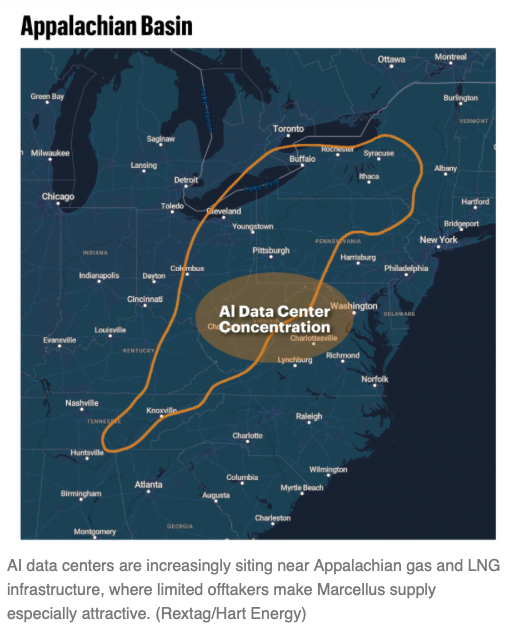
Appalachia produces a huge amount of natural gas, mainly from the Marcellus and Utica shales, about one-third of all the gas in the U.S. What is changing now is not how much gas is in the ground, but who needs it and where.
Data centers, especially those powering AI and cloud computing, use massive amounts of electricity and need cheap, reliable energy 24/7. Appalachian natural gas fits that need perfectly. It is close, abundant, and already connected by pipelines, making it attractive for companies building data centers nearby.
In the past, growth in this region was held back because there were not enough pipelines to move the gas. New pipeline capacity is easing those limits, allowing gas to flow to places like Virginia and West Virginia, where data center construction is booming.
Instead of wild growth or price spikes, Appalachian gas is seeing steady, demand-driven growth. Simply put: there is plenty of gas, real buyers who need it long term, and better ways to move it. That combination makes this region a stable and important part of America’s energy future.
 |
U.S. Tanker Seizure Tightens Oil Supply Lines, Not Supply
The U.S. seizure of oil tankers tied to sanctioned Venezuelan oil sends a strong message: illegal oil shipments will be stopped anywhere in the world. This action doesn’t add oil to the market, it actually makes moving oil riskier and more expensive for countries and companies trying to go around sanctions.
For U.S. consumers, this is mostly a stability story, not a price spike story. While tougher enforcement can add some cost to global shipping, it also reduces uncertainty and discourages black-market oil flows that can cause sudden price swings. That helps keep gasoline prices from becoming wildly volatile.
For U.S. oil producers, this is generally supportive for prices. Cracking down on sanctioned oil limits unfair, under-the-table supply and helps keep the market balanced. Producers benefit from steady, predictable pricing, which allows them to plan drilling, invest responsibly, and return value to investors. The bottom line is that this move does not mean higher prices overnight, but it does support a more orderly oil market, one that is better for U.S. producers and more stable for consumers.
Congressman Says U.S. Needs to Refill Its Emergency Oil Reserves
West Texas Congressman Pfluger is urging Washington to refill America’s emergency oil reserves, known as the Strategic Petroleum Reserve (SPR), which is meant to protect the country during major supply disruptions.
Right now, the SPR is at one of its lowest levels ever after a large amount of oil was released in 2022 to help lower gas prices. The reserve was originally created as an insurance policy in case of wars, natural disasters or global oil shortages.
The congressman says letting it stay this low is risky, not just for energy security, but also because the underground salt caverns that store the oil need to stay filled to remain structurally sound. In simple terms: the U.S. used its emergency reserves, and now it needs to refill it so the country is better prepared for future disruptions and energy shocks.
Happening at King
 |
Reid Ryan on Astros Sign-Stealing Scandal & MLB’s Post-COVID Future
In this special throwback episode of The Jay Young Show, Reid Ryan joins me for a powerful conversation revisiting one of the most controversial moments in modern baseball history, the 2019 Houston Astros sign-stealing scandal, and exploring the future of Major League Baseball in a post-COVID world. Reid shares firsthand insight into leadership, accountability and resilience during his tenure as President of the Houston Astros, where the organization achieved five consecutive years of record-breaking franchise revenue, elevating the Astros into the upper echelon of MLB’s most successful clubs. Don't miss this powerful episode.
Watch it on LinkedIn, Rumble and YouTube (@JayRYoungOfficial).
Moves to Watch
Vistra Buys Major Gas Power Portfolio for $4.7 Billion
Vistra is buying a large group of natural gas power plants from Quantum Capital Group for $4.7 billion. The deal includes 10 modern power plants that can produce enough electricity for millions of homes, located across the Northeast, Midwest and Texas.
Vistra is paying part cash, part stock, and taking on some debt, which brings the real cost closer to $4 billion after tax benefits. The purchase makes Vistra one of the largest power producers in the country and strengthens its ability to provide reliable electricity as demand continues to grow.
If you'd like to talk to someone about King and are an accredited investor, you can fill out your information here or schedule a Zoom conversation with one of our SVPs here and someone will reach out.
All the best,
Jay